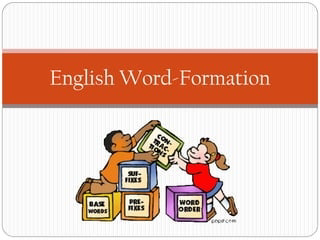
Word Formation
Word Formation is the way in which new words are formed from the root word in a language. Every language has its own structural patterns of word formation.
Word Formation is the branch lexi ology which studies derivative structure of existing words and patterns on which a language builds new words.
A few of the major word formation methods in English are - compounding, derivation, conversion, blending, clipping, acronyms, back formation, reduplication and abbreviation.
Compounding
In linguistics, Compounding is an important word formation process in which two or more words are joined together to form new words.
Examples:
Wall + Paper = Wallpaper
Home + Work = Homework
Foot + wear = Footwear
Tea + Powder = Tea Powder
Derivation
Derivation is another form of word formation. The most common type of derivation is the addition of one or more affixes to the root word.
Adding a word in front of a root word is called prefixation
Injustice
Discharge
Unhappy
Displace
Adding a word after the root word is called suffixation.
Faithful
Cooked
Kindness
Adding words in between words is called infixation.
mother-in-law
Conversion
Conversion is the process in which same words are used as verb and noun by converting only the class.
Use(Noun) - To use(verb)
Brush(Noun) - To brush(verb)
Clipping
Clipping is the process in which new words are formed by taking a part of an existing word. For Example taking ad from Advertisement.
Exam - Examination
Plane - Aeroplane
Fridge - Refrigerator
Prof - Professor
Phone - Telephone
Blending
Words created by blending or merging two words are called blends. An example of a typical blend is brunch, in which the beginning of the word breakfast is joined with the ending of the word lunch.
Breakfast + Lunch => Brunch
Smoke + fog => Smog
Excalator + air => Excalair
Motor + hotel => motel
Acronyms
Acronyms are formed by taking initial letter of a phrase and make it a new word.
Here are a few examples of popular acronyms:
PIN = Personal Identification Number
U.S.A = United State of America
UK = United Kingdom
Back Formation
In back-formation, the reverse process is applied to existing words in order to create a new word. For example, if the suffix ''-er'' is removed from the word ''teacher,'' the verb ''teach'' is created.
Televise - Television
Emote - Emotion
Beg - Beggar
Housekeep - House Keeper
Escalate - Escalator
Metanalysis
The formation of a new word through a mistaken analysis of a boundary between existing words. A typical example is the word adder, derived from Middle English naddre through people mishearing the phrase a naddre as an adder.
These are major word formations in English Language. Inorder to enrich our vocabulary, we should aware about the origin of new words day by day.